.png)


Subscribe to our newsletter
Subscribe to get exclusive insights, invites, and expert tips from the Localintel team.
Oops! Something went wrong while submitting the form.



The demands on a one or two-person team span the full range of the function – investor inquiries, council reporting, grant applications, site selector requests, community marketing, website maintenance – often landing in parallel, often with no clear order of priority. What gets done is what gets prioritized. Everything else waits.
Most economic development officers at small municipalities are not short on effort or expertise. They know their communities deeply. They understand what investors want to see, what council needs to hear, and what a site selector is actually asking when they submit an inquiry.
The challenge is the gap between knowing what needs to be produced and being able to produce it – consistently, quickly, and to a standard that holds up.
Pulling current, credible data takes time. Finding it from sources that are defensible, that you can confidently put in front of council or attach to a grant application, can take longer. Turning that data into a finished deliverable – are port, a workforce analysis, a map, a chart, a council briefing, a web page that looks professional – typically requires either specialist skills or outside help. The reports and profiles that many larger municipalities commission from consulting firms such as community overviews, workforce analyses, sector studies, economic snapshots aren’t a realistic option on a small-team budget or timeline. Neither is a dedicated communications person to turn research into finished content.
So, things get delayed. Or done with whatever was available at the time. Or they don’t get done at all.
Site selectors and investors evaluate communities. They do it across many communities at once, and they apply the same standard regardless of a municipality’s size or resources. A small rural town competing for a logistics facility or a food processing operation is compared, directly, against larger centres with larger teams and larger budgets.
Whether the community profile is current matters. Whether there’s a credible workforce summary ready to share matters. Whether a council briefing reflects the latest available data matters. That gap is visible to anyone doing the comparison.
That’s not an argument for giving up. It’s an argument for finding a better starting point.
Mary Lee Prior is the Economic Development Officer for the Town of Vermilion, Alberta. Like many small-municipality ED officers, she manages the economic develop mentfunction largely on her own.
She’s recently added a set of professional reports to Vermilion’s economic development website using Localintel’s content platform including a Workforce Report, a Demographics Report, a Community Overview, and a Mobility & Commuting Report, each drawing from verified government sources and curated third-party datasets. For a site selector or investor arriving at the site with no prior knowledge of Vermilion, those reports do the work of establishing what kind of community it is: its labor force, its population profile, its commute patterns, its economic makeup.

What makes that achievable for a one-person operation is that the reports are built from current, verified data and ready for review, without requiring Mary Lee to source figures, structure a document, or produce a professional layout from scratch. The production work is already done. Her role is to evaluate the content, apply her knowledge of the community, and publish what fits.
That same starting point applies beyond the website. The same platform content that becomes a downloadable report for a site selector can be drawn on for a council briefing, adapted for a grant application, or shared in response to an investor inquiry, without rebuilding from scratch.
For small-team economic development offices using Localintel’s platform, the content that would typically require a consultant or a specialist is available as a structured, reviewable starting point: community profiles, workforce analyses, sector reports, demographic overviews, charts, maps, and website widgets that update as new data releases, including data from the 2026 Canadian Census as each tranche lands through 2027.
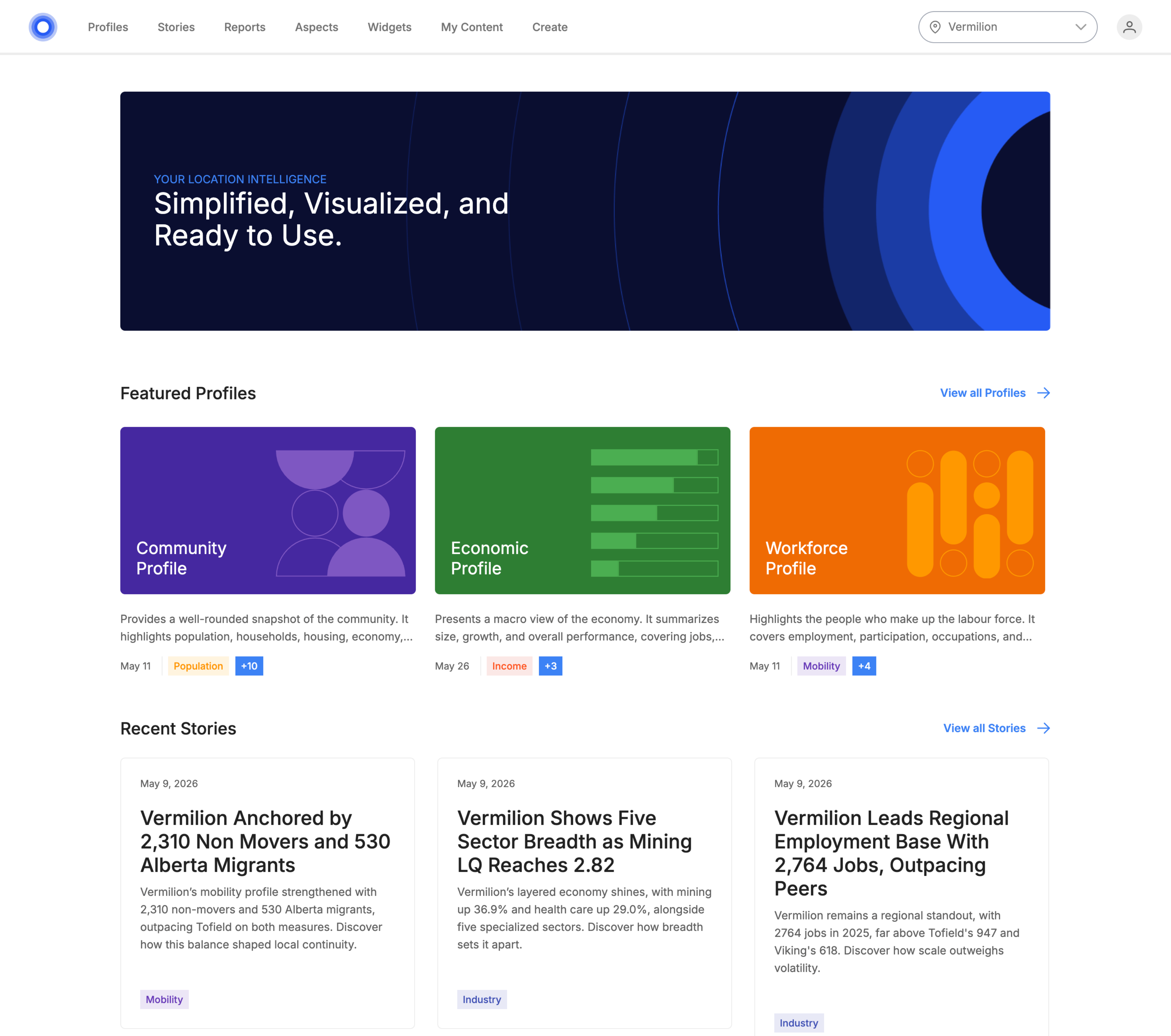
The platform draws from official government sources and curated third-party datasets, so the underlying figures are traceable and defensible, important for a team that answers directly to council for everything it publishes. Content is ready for staff review, not raw data that requires specialist interpretation before it can be used.
The practical result is that one person can respond to an investor inquiry with current figures, prepare a council summary without starting from a blank page, and keep community materials up to date, without the production work that usually makes those tasks crowd each other out.
If you’re running economic development for a small municipality, and doing most of it yourself, the question worth asking is how much time goes into finding, formatting, and assembling information rather than using it.
Localintel works with single-person economic development offices across Canada. To see what the platform looks like for your community specifically, book a time with us.

Welcome to a whole new way to communicate your location’s advantages.
