.png)


Subscribe to our newsletter
Subscribe to get exclusive insights, invites, and expert tips from the Localintel team.
Oops! Something went wrong while submitting the form.



The team now publishes data-backed stories, generates reports and community profiles, and keeps their website stocked with current, interactive data and drawing from the same underlying sources their consultants used, but without the cost or the wait.
Economic development is a content-heavy job. Research from Localintel’s annual survey of economic developers found that 93% say creating and sharing data-informed content is essential to their success, and 54% are doing it daily or weekly. The work spans keeping websites current for investors and site selectors, responding to business inquiries, preparing council briefings, and supporting public communications – nearly all of it requiring data that is credible, current, and in a form staff can use without specialist help.
For Red Deer County, the bottleneck came down to two things. Their website needed to give investors, site selectors, and businesses the data they look for early in their research – the kind of information that helps them understand a location’s strengths and decide whether to dig deeper. And their content production process depended too heavily on outside consultants: an external group produced an annual community profile, with a two-page snapshot also in the queue to commission.
Red Deer County draws from the Localintel platform’s library of widgets – interactive data tools embedded into website pages – to give investors and site selectors current, verified information during the early stages of their research.
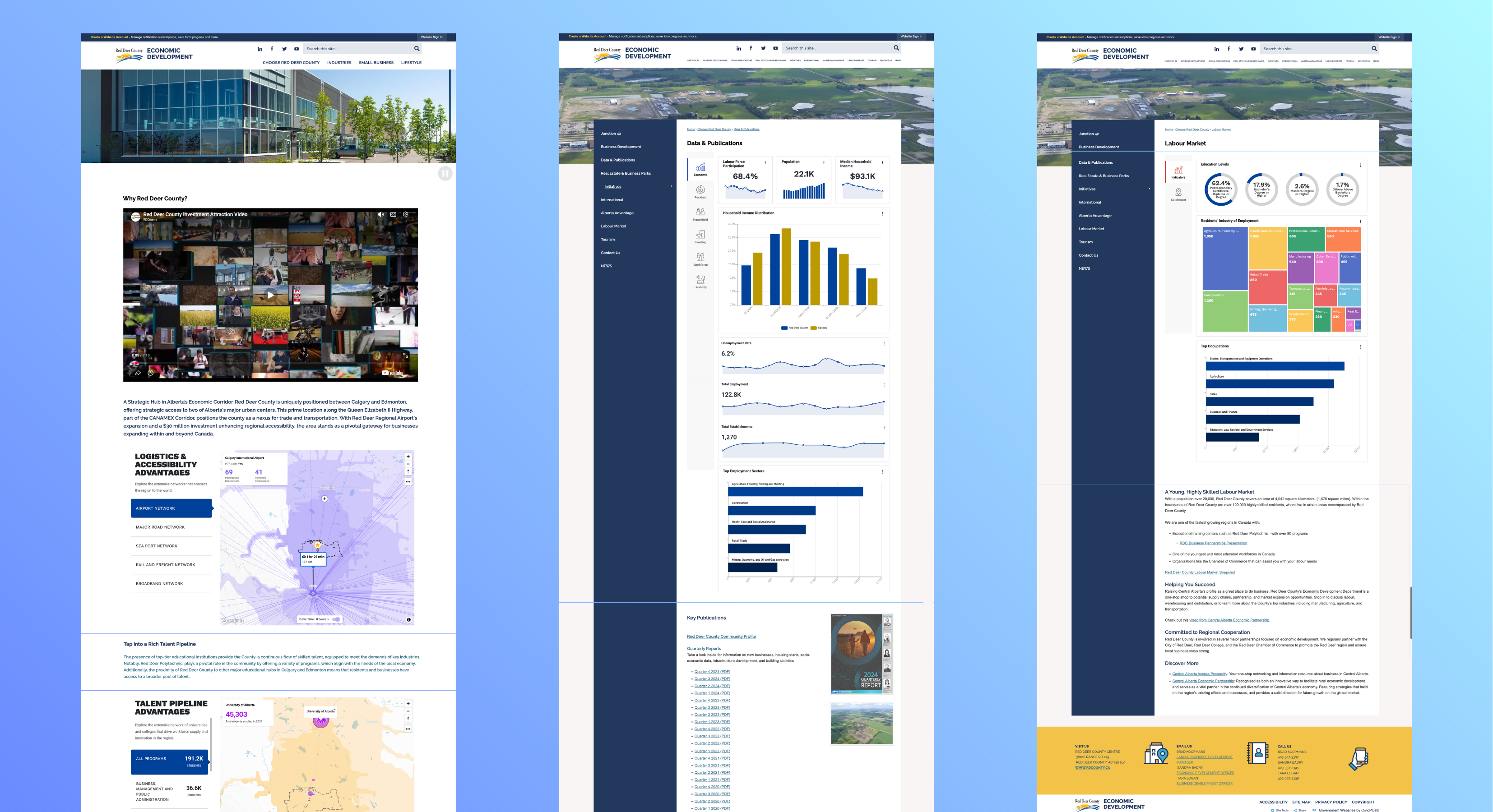
On their Why Red Deer County page, six widgets do the work that investment attraction pages are designed to do. The Logistics and Accessibility Advantages widget lets investors and site selectors explore the transportation networks connecting Red Deer County to markets – road, rail, air, and broadband – with drive times from key locations. Access to markets is one of the top site selection factors for businesses and this widget surfaces that story in an interactive format visitors can explore at their own pace. Alongside it, the Quality of Life widget showcases what life in the county actually looks like – the livability data that matters to businesses thinking about where to attract and retain talent.
On the Data & Publications page, the Community Profile widget presents a comprehensive picture of Red Deer County – economy, population, household data, workforce, and more – across six interactive dashboards with dynamic maps and downloadable charts. And on the Labour Market page, the Workforce Advantages widget gives businesses and site selectors a detailed view of the county’s labor force: educational attainment, industries of employment, and occupations, in a format built specifically for that audience.
All widgets draw from verified sources. Localintel maintains and updates the databehind them – the team does not have to.
Red Deer County’s team has access to a growing library of platform-generated stories they can edit and publish directly. Business Development Officer Tara Logan published the team’s first story – “Red Deer County Builds on Trades Strength While Broadening Its Educational Mix” – within days of getting access to the platform. The content required minimal editing and once the new page was set up in their website system, getting the story live took under three minutes.
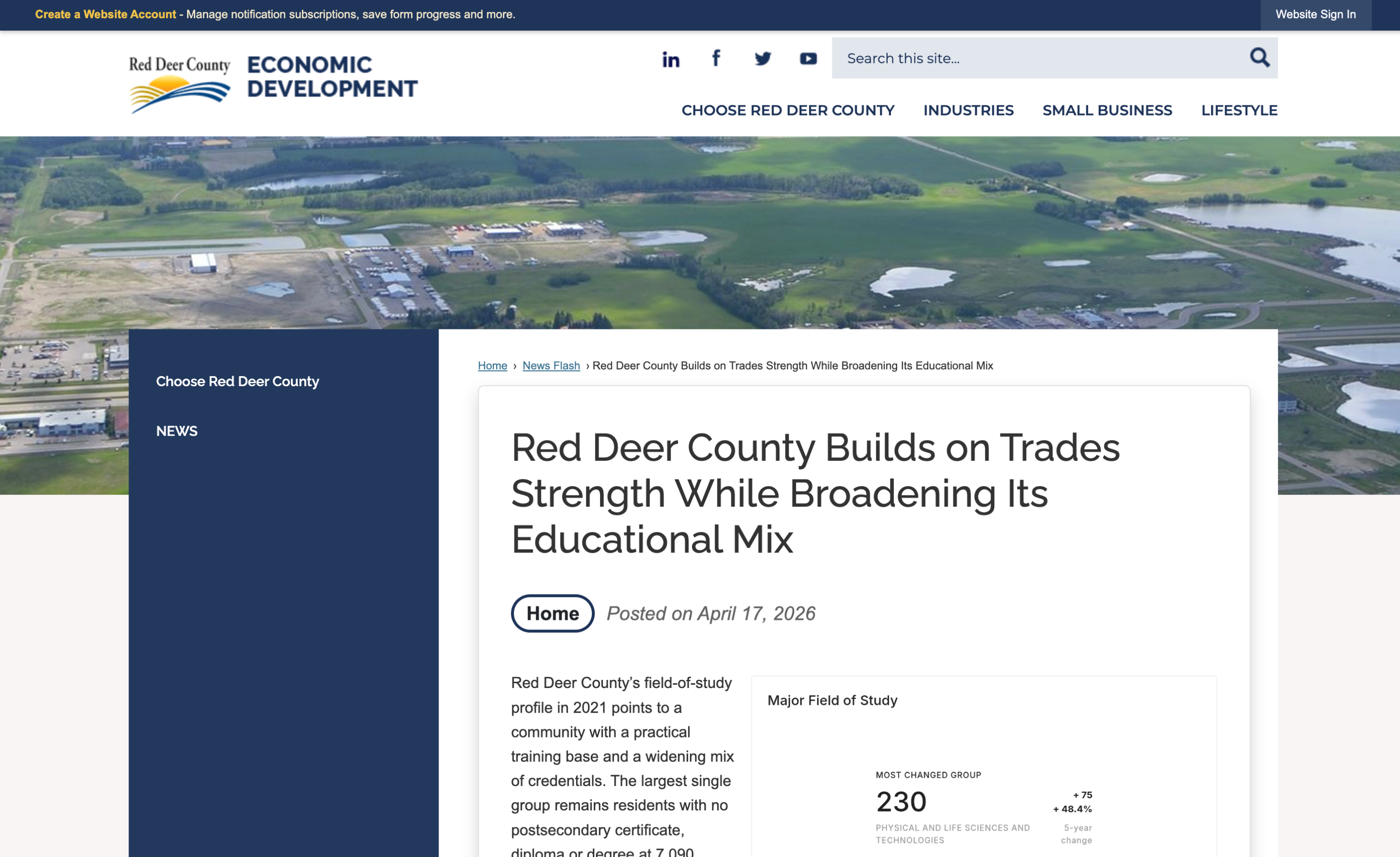
The team is now planning a regular cadence: a platform-generated story each week, supplemented by their own County-specific content, coordinated with their communications department for social media promotion.
Through the Localintel platform, the team has access to reports and interactive profiles covering Red Deer County’s economy, workforce, industry sectors, demographics, and more – across the same range of topics, from community overview to individual industry sectors.
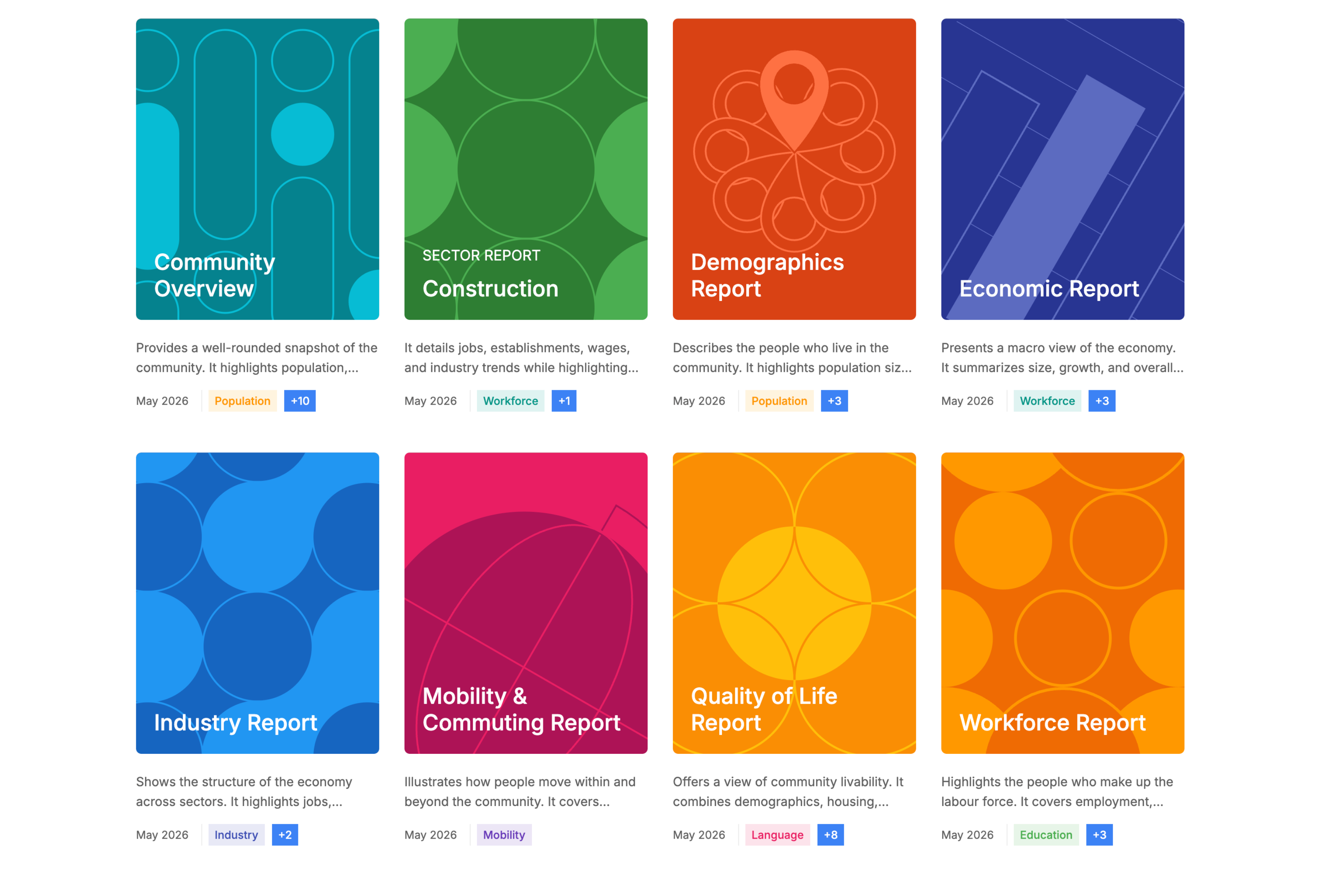
Reports are publication-ready PDF documents: structured, narrative-driven content with analysis, charts, and data in a format ready to send to council, attach to a briefing, or hand to an investor. Profiles are a different kind of output –interactive online experiences with dynamic charts, maps, and key metrics that anyone can view via a shareable link, no platform access required. A team member can send an investor or a council member a direct link to a polished, data-rich view of the community – the kind of content that used to require commissioning and weeks of turnaround.
This is the capability that directly displaces their annual consulting commission.
“As far as building our own community profile, we see a lot of benefit there — a lot of value. We’ve been commissioning a group to provide us with a community profile annually. We feel we have what we need in the platform to produce that ourselves.” Tara Logan, Business Development Officer, Red Deer County
The Localintel platform automatically updates as new data is released across all data sets. For Red Deer County, one of the most significant upcoming updates is the 2026 Canadian Census. Statistics Canada begins releasing that data in November 2026, with subsequent releases running through December 2027 covering population and dwelling counts, age, income, families and households, labor, education, housing, and more. As each release comes through, the platform will automatically incorporate those updates across the team’s reports, profiles, stories, and website widgets. When council asks what the latest census says about the County, the team will already have the answer ready.
The team is working to introduce the platform to their planning department – a group they see as an obvious fit, given the volume of data-heavy content planners produce for council and public engagement. They’re also planning to use platform visuals at upcoming community open houses. With three active users and two seats still to assign, those expansions are already in motion.
For economic development teams that rely on outside consultants, manual research, or static web pages to tell their location’s story, Localintel’s content platform provides a different way to work: current data on the website, publish-ready content on demand, and content that stays current as the underlying data does.

Welcome to a whole new way to communicate your location’s advantages.
